The Natural Colour System (NCS) is a perceptual colour model that organises colours based on human perception. The starting point is not how colours are made, but how colours are seen.
The system describes every colour using psycho-visual characteristics that are recognisable to everyone, regardless of language, discipline or technical knowledge.
1. The Six Elementary Colour Associations
Research into colour perception has shown that people spontaneously relate colours to six fundamental colour associations:
W – White
S – Black
Y – Yellow
R – Red
B – Blue
G – Green
All other colours are perceived by the brain as combinations or resemblances of these six.
These six form the psychological foundation of the NCS system.
2. Three Perceptual Dimensions of Colour
Every colour we see can be described using three visual characteristics:
a. Blackness association
How much resemblance a colour has to black.
b. Whiteness association
How much resemblance a colour has to white.
c. Chromaticness
The degree of colourfulness — how powerful or present the colour is.
This is not saturation in a technical sense, but a perceptual intensity.
These three dimensions together form the visual nuance of a colour.
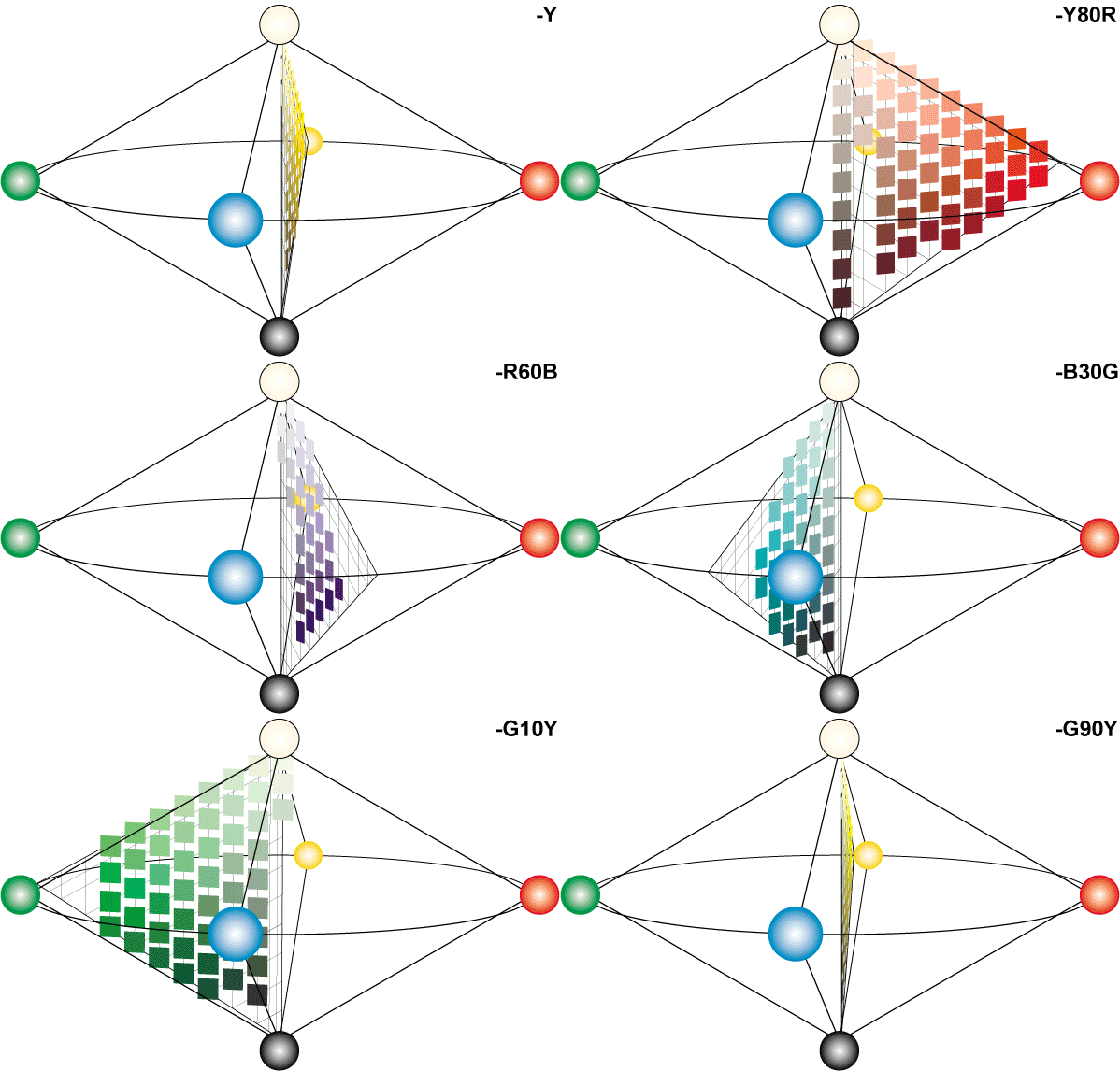
3. Hue and the NCS Colour Circle
In addition to the nuance dimensions, NCS uses a hue component to indicate how a colour relates to the elementary colour associations.
A colour may, for example, show resemblance to:
- →Yellow
- →Yellow → Red
- →Red → Blue
- →Blue → Green
- →Green → Yellow
These positions form the NCS colour circle.
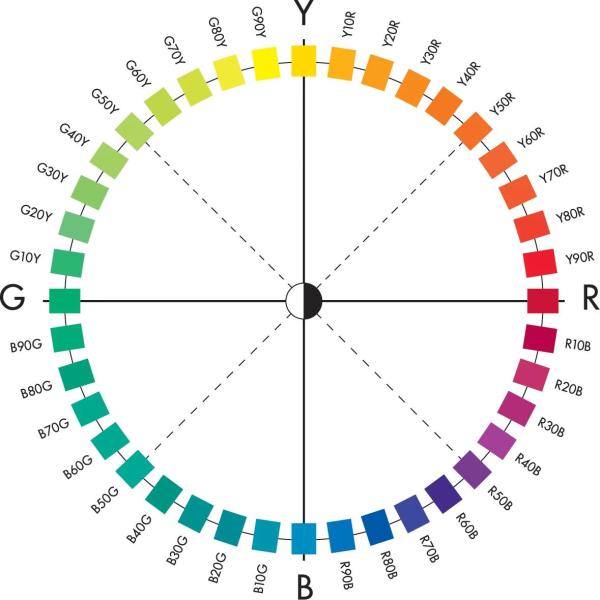
It is a perceptual, not a physical circle.
Important:
The NCS colour circle is not based on pigments or light wavelengths, but on how people subjectively organise colours in a logical pattern.
4. The Nuance Structure (Triangle Model)
In addition to the colour circle, the NCS structure includes a nuance triangle, in which every colour is assigned a ratio of:
This allows every colour to be placed purely visually within the three-dimensional NCS model.
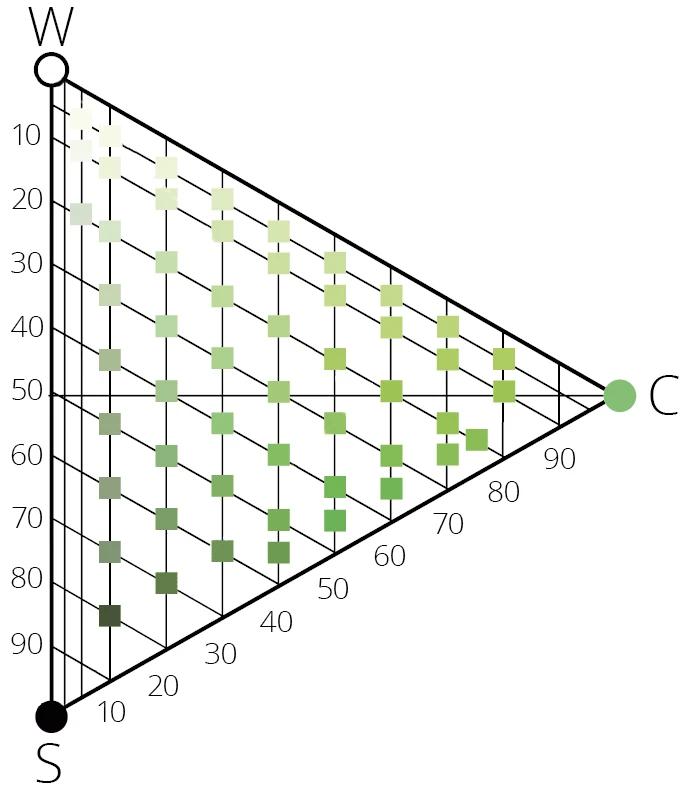
Important distinction:
- →The nuance describes how strong a colour is.
- →The hue describes which direction the colour has.
5. Why NCS Is Scientifically Consistent
NCS is theoretically stable because:
- ✓it is based on human vision, not on technical models
- ✓the structure aligns with how our brain forms colour categories
- ✓colour relationships are logical and reproducible
- ✓all colours can be described without material or pigment
- ✓the system is independent of paint technique, digital colour models or light source
This makes NCS applicable in any design, production or technical context.
6. Applicability of the Colour Model
The strength of the theory is that it:
- •is independent of technology
- •works consistently across materials
- •intuitively aligns with how people understand colour
- •provides an exact starting point for all further NCS applications
This allows the model to function as the backbone of professional colour communication.
Apply the theory in practice?
Physical NCS references such as colour fans and samples are essential for correctly applying the perceptual theory.
Browse all NCS colour fans and colour samples in the webshop of the Netherlands Colour Institute.
Want to learn more about NCS theory?
Follow the comprehensive Online NCS Colour Course from the Netherlands Colour Institute via the Kleurenschool.
View the online course →